orbilift
orbilift
orbilift

1.0
welcome
and thank you for visiting Orbilift.
Orbilift is a research firm developing mobility technology, to help elderly people live independently.
It is astounding that most personal mobility devices, such as wheelchairs and mobility scooters, are difficult, if not impossible to use in normal homes. Their wide turning-circle becomes a problem in tight spaces, such as the bathroom and kitchen.
Orbilift is solving this, with a special wheel that propels in any direction.
Another shortcoming in personal mobility devices, is their inability to climb stairs. The fact is, many elderly people struggle to climb stairs.
Orbilift is solving this, with a stair-climbing mobility chair.
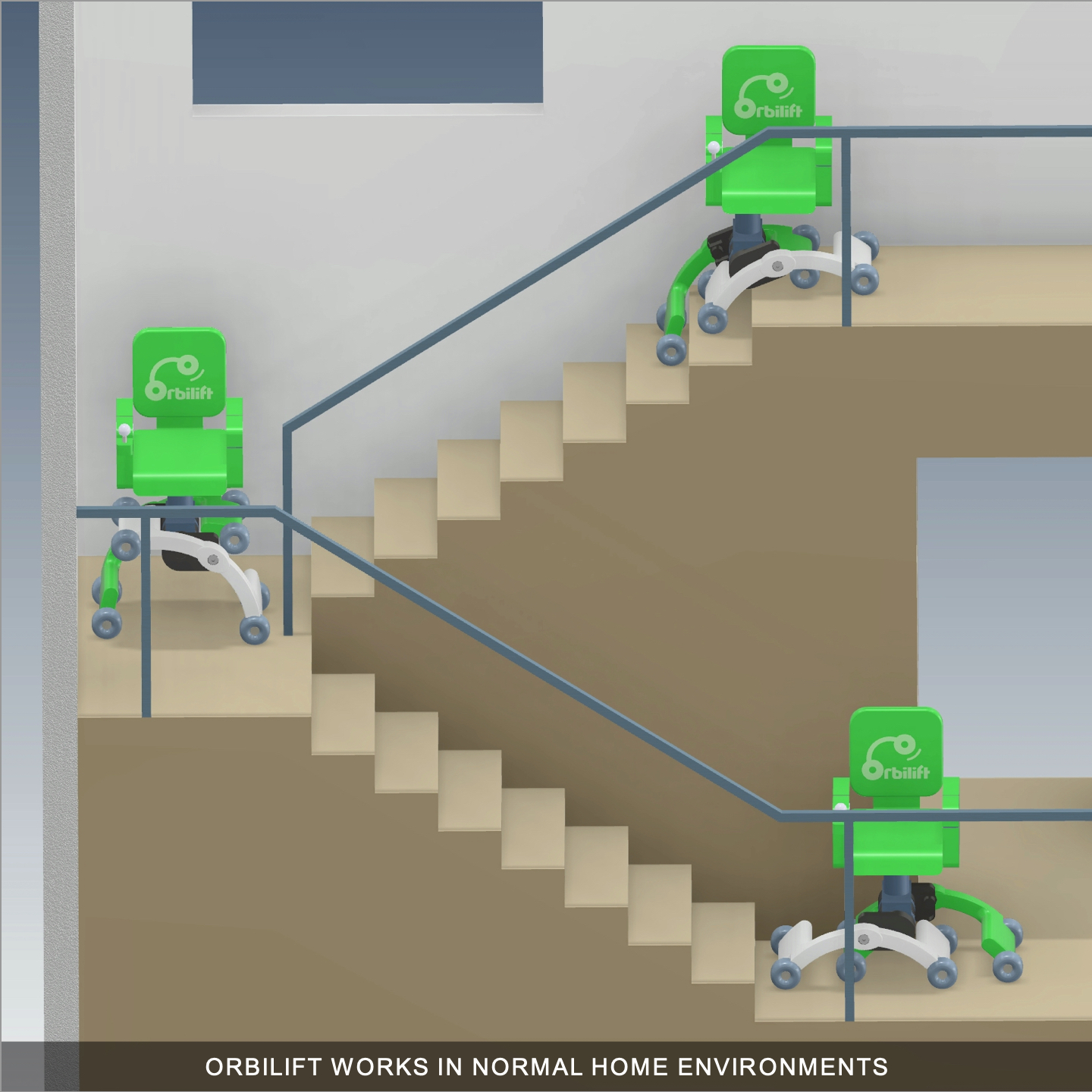
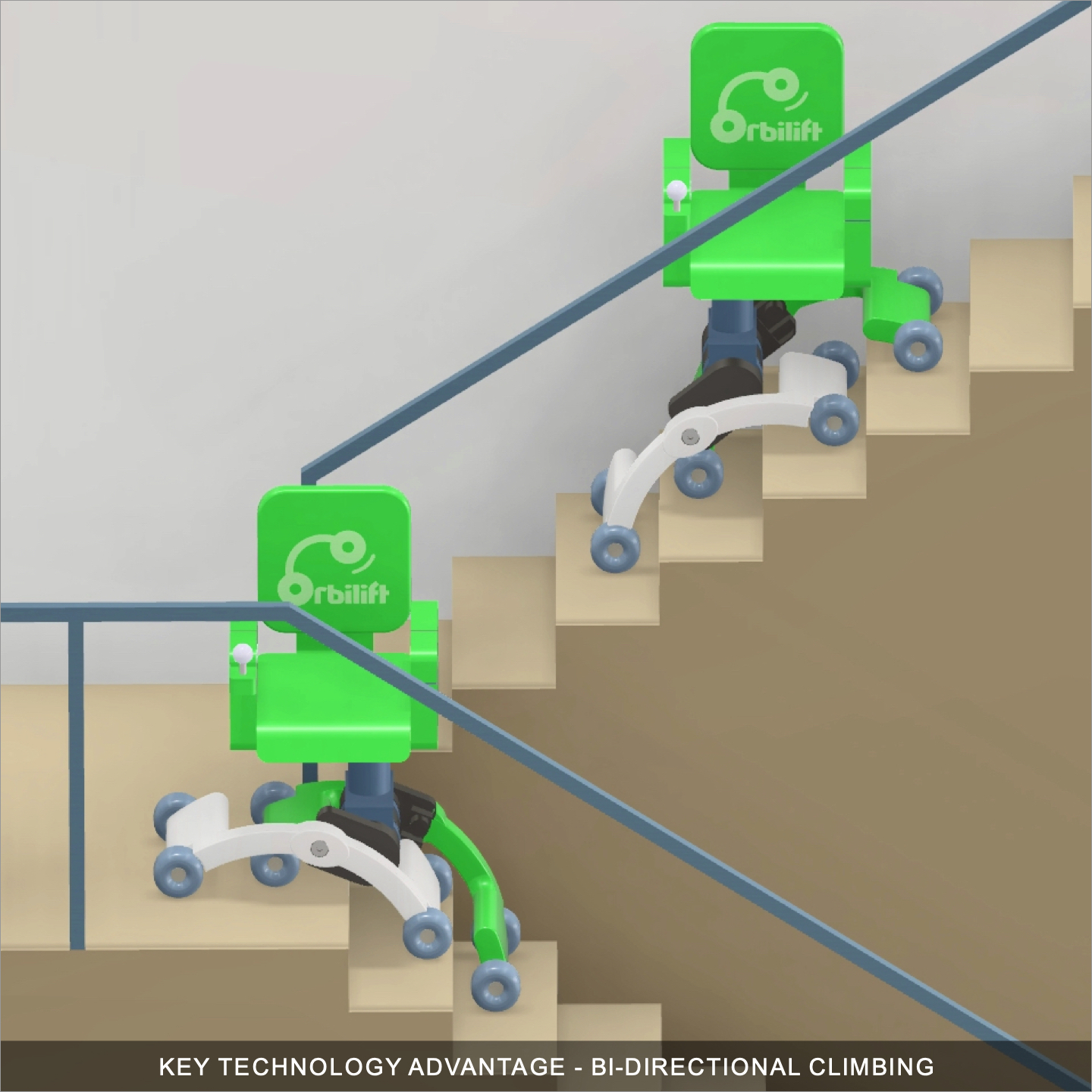
Please watch the video above. The unique, bi-directional-climbing action of the Orbilift mobility chair, enables navigation of a U-turn stair, common in many homes.
Other stair-climbers get trapped on the mid-landing, due to their wide turning-circle.
Orbilift's bi-directional-climbing solves this problem, by simply bypassing the need to physically turn, at the mid-landing.
Bi-directional-climbing is Orbilift's key technology advantage. It makes homes navigable and liveable.
•
Orbilift was founded by an Australian architect, who realised that mobility products are more useful, when they fit the normal home environment. In short:
Environmental fit = Customer fit
Our breakthrough technology can help a lot of people. After all, we all get old and decrepit, and most of us love our homes. That’s a big demographic.
•
Thank you for reading the introduction. This website has a number of sections.
Keep scrolling down to read about the mobility chair and how it works. Or use the menu bar, to explore design and social impact.
Investment and business enquiries - hit the button below for market analysis and patent licensing.
August 2026 News
We announce our official participation in the following government programs:
In Australia, Orbilift is now part of the Australian Government's Industry Growth Program - aimed at boosting national capability in technology and health.
In Japan, Orbilift is now part of the Japan External Trade Organisation's J-Bridge Program - linking advanced, new technology from around the world, with Japan's industrial sector.
Both Australia and Japan have ageing populations. We thank the governments of both nations for their support.
1.1
3d mobility
The "Orbilift" is a new mechanism for use in transport. It moves in two ways - it climbs and rolls. This makes it more versatile than a wheel, because a wheel only rolls.
Whilst the wheel is a good invention, it has a problem. It stops if it meets an obstacle. When Orbilift meets an obstacle, it climbs over it.
In short:
A wheel travels two-dimensionally, across a surface. Orbilift travels three-dimensionally, up, down and across.
Wheels = 2D mobility
Orbilift = 3D mobility
1.2
climbing mode
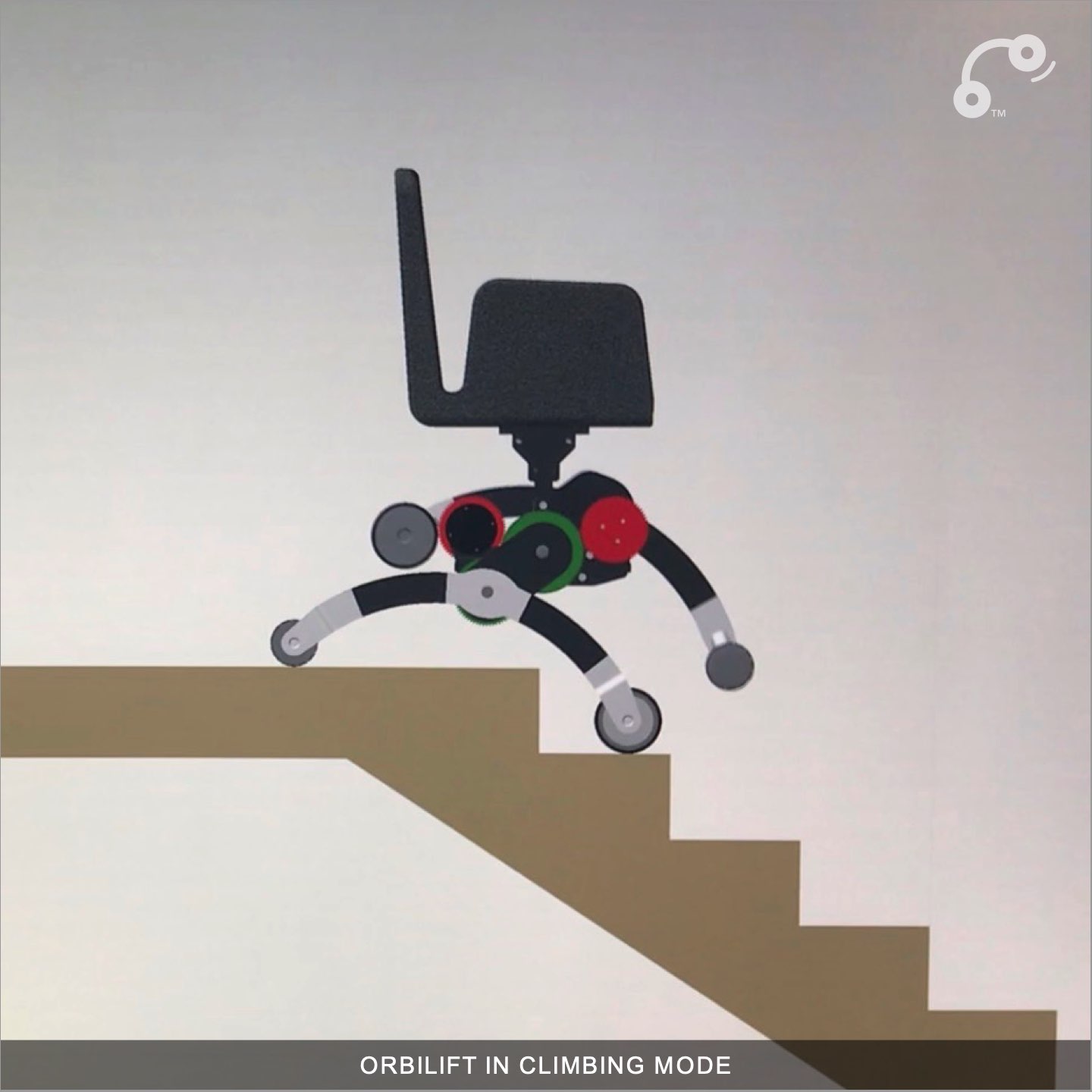
Orbilift climbs by lifting, like a crane. One part stays on the ground, whilst the other part lifts and moves. It is stable as it moves, making it safe around humans.
The mechanism can be thought of as: two cranes sharing one arm, to lift each other, from one place to the next.
As it lifts, one crane orbits the other, hence the name of the device: Orbilift.
It has a stable platform for carrying goods and people. A counter-rotating gear, beneath, keeps the platform horizontal, as Orbilift climbs.

1.3
rolling mode
Orbilift has motorised wheels, similar to a power-wheelchair.
In rolling mode, it is compact and normal-looking. This improves social inclusivity for the user.
Existing types of vertical-transport, such as elevators and escalators, are fixed. Orbilift is not fixed. It roams between different buildings, giving the user much greater freedom.
One Orbilift can serve several, different buildings, lowering the cost of providing vertical transport.
1.4
transformation
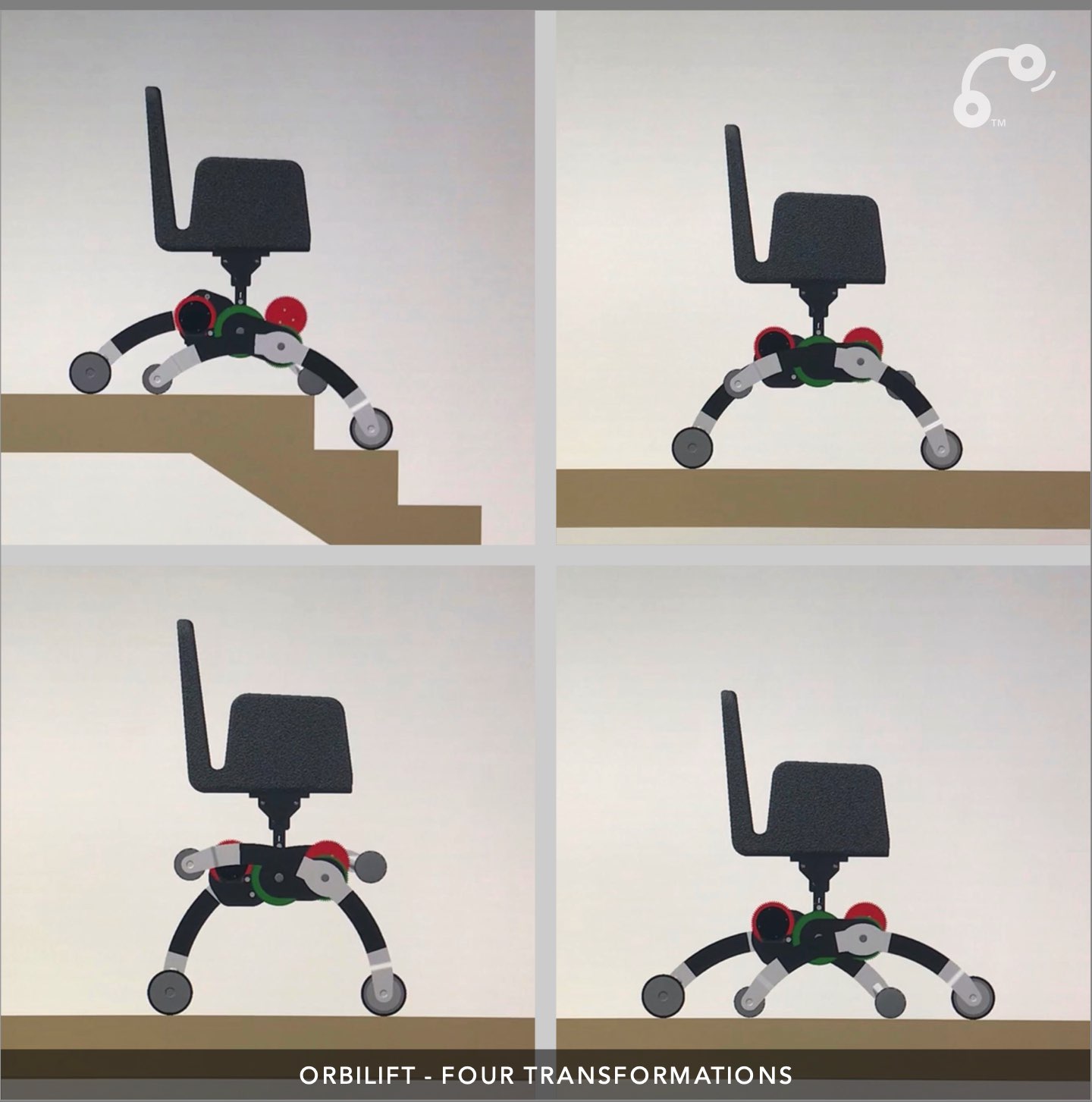
"looks like a chair, climbs up a stair"
1. Climbing mode: for stairs, kerbs and other obstacles;
2. Rolling mode: for flat ground, footpaths and ramps;
3. Small footprint / high position; for manoeuvring in confined areas + reaching high benchtops;
4. Large footprint / low position: for sitting at low height tables.
1.5
less is more
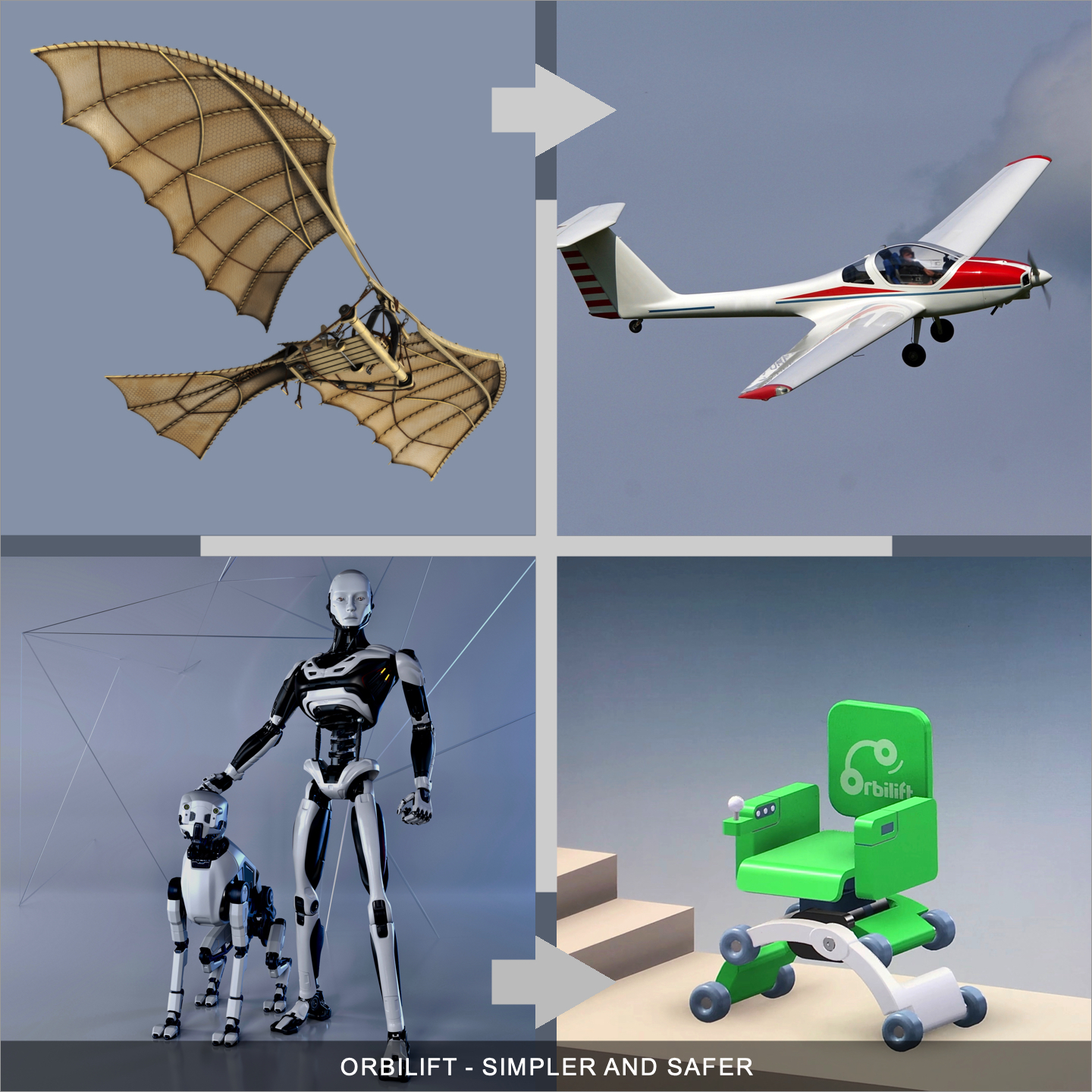
Engineers sometimes copy animals. This introduces unnecessary complexity.
Leonardo da Vinci’s “ornithopter” had two flapping wings. Whereas a single wing is a better solution.
When a humanoid lifts its mechanical legs to move, it becomes unstable. Falling down is an issue
Orbilift is always supported on four wheels and it uses a single lever to lift itself.
Orbilift's simple design is safer and more practical than a humanoid.

1.6
adaptivity
The natural world is three dimensional. But wheels can only move two dimensionally.
We flattened the world, to make way for the wheel.
Orbilift moves three dimensionally. Unlike the wheel, it does not require the world to be flattened. It adapts to uneven terrain.
A new family of robots arise from Orbilift. Uses include: climbing transporters for delivering goods, and stair-climbing mobility chairs.
_________________
END OF SECTION 1
© ORBILIFT PTY LTD, AUSTRALIA 2026
THIS WEBSITE IS FOR GENERAL CONSIDERATION ONLY. NO CONTENT MAY BE USED FOR: TECHNICAL, COMMERCIAL, LEGAL, ACADEMIC OR JOURNALISTIC PURPOSES. THE ORBILIFT IS IN MID-STAGE DEVELOPMENT AND OUTCOMES MAY DIFFER FROM PROJECTIONS. ORBILIFT IS PROTECTED WITH PATENT-FILINGS AND TRADEMARK-FILINGS IN MULTIPLE JURISDICTIONS, GLOBALLY.